Open Water
People can go a long time without food. Most people have enough fat reserves to last about 30 days. Without water it is about three days.
Most of that water comes from the tap. When there is lead in the pipes, a blockage or a shortage, there is no backup.
In Puerto Rico a lot of people don't trust the tap water, and the supply is not reliable. In June a crack in a main pipe left tens of thousands of people in and around San Juan with no running water until it was repaired.1 In August a drought led to rationing for about half a million people around San Juan: 48 hours with water, then 48 hours without. The government says more than half of the water supply is lost to leaky underground pipes.2
So people buy bottled water at Costco. It is shipped a long way by freight. It sits in plastic in the sun and the weather. It takes a lot of energy and resources to get it there. It is heavy, and no one likes carrying 80 bottles of water to the car and into the house.
Rainwater collection works, but not everywhere. You may not have the space, you may not be able to set it up, or it may not rain much where you live.
The air holds water too. An atmospheric water generator condenses humidity out of the air into drinking water. The technology has existed for a long time, but it is mostly sold for large or off-grid setups. The cheapest machines I found were $800 to $900, and most cost $1,000 to $2,000 or more. They are big, loud, inefficient and hard to ship, and they are not made to be repaired at home.
Many of these machines are a dehumidifier built with food-safe materials. A dehumidifier already pulls water out of the air: a fan moves air across a cold coil, and the water condenses and drips into a tank. Home dehumidifiers are rated at about 20 to 50 pints of water a day, which is 2.5 to 6 gallons.3
You can't drink that water. It is meant to be thrown away, so the parts it touches can be copper, aluminum and sometimes lead solder.
Open Water condenses water from the air, uses food-safe materials wherever the water touches, and drips it through a carbon filter into a 2-liter jug. A reverse osmosis filter costs $150 to $200, and one can be added to an outlet on the back.
The parts are:
- An air filter on the top, where the air comes in. More filters can be stacked on it.
- A fan and two coils, which are the dehumidifier part.
- A food-safe path for the water.
- A carbon filter in the lid of the jug, and a UV-C light above it.
- A water outlet on the back for add-ons such as reverse osmosis. It makes its own water, so there is no inlet.
It is designed around four things:
- Repairability
- Modularity
- Robustness
- Optimization: weight, efficiency, noise, size, electricity use and cost
It should cost about what an affordable water system costs, and last for many years.
It won't make enough water for showers. The goal is drinking water. The usual recommendation is one gallon per person per day,4 and because it is modular you can add units for more. It is for emergencies, and for anyone, anywhere, who wants to make their own water.
So far there are basic CAD drawings and designs. Claude has helped a lot, because I don't know the materials well. Nothing has been built or tested yet, and nothing is for sale.
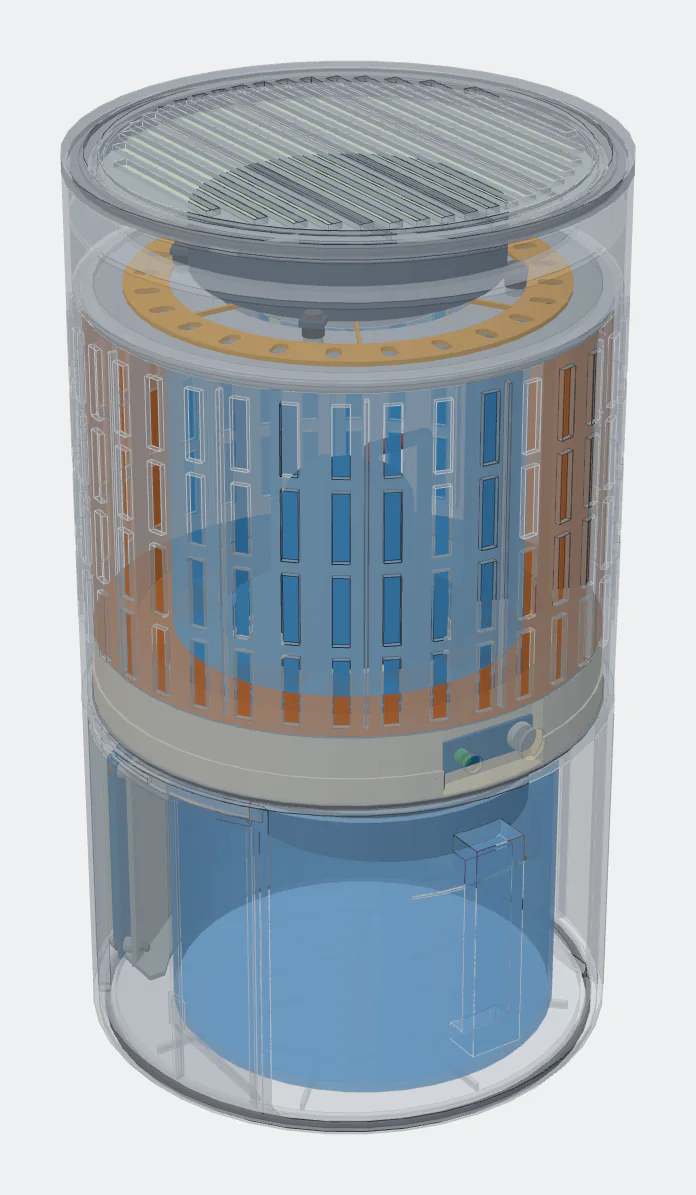
The Open Water page has the 3D model, the drawings, the parts and a preorder list.
Footnotes
- Source: NPR https://www.npr.org/2026/06/16/nx-s1-5860661/the-daily-toll-of-no-running-water-in-san-juan-puerto-rico
- Source: NPR https://www.npr.org/2026/08/06/nx-s1-5922450/amid-severe-drought-puerto-rico-to-begin-rationing-residents-water
- That is at 65°F. Warmer, more humid air holds more water. Source: ENERGY STAR https://www.energystar.gov/products/dehumidifier_testing_and_capacity
- Source: Ready.gov https://www.ready.gov/water