Meshtastic vs MeshCore
Meshtastic and MeshCore both send text messages over small LoRa radios, with no cell service and no internet. They run on the same hardware. But they are separate networks and can't talk to each other, so each radio runs one or the other.
The real difference is how a message gets from you to someone 50 miles away.
Meshtastic: everyone repeats
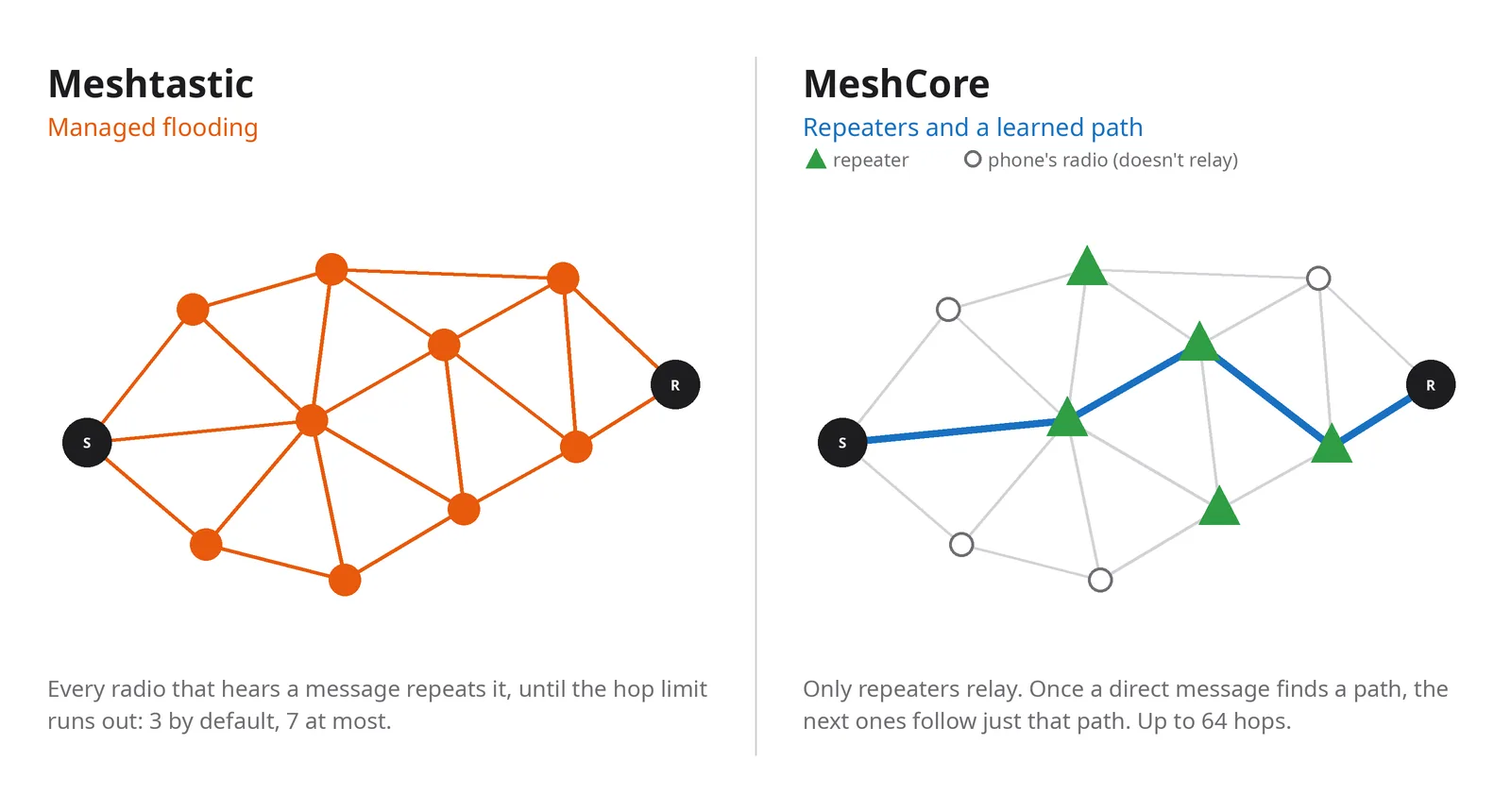
Meshtastic is built on flooding. When a radio hears a message, it repeats it. The radios that hear that copy repeat it again, and so on, until the hop limit runs out. The default is 3 hops and the maximum is 7.1 To keep the air from filling up, a radio holds back if it hears a neighbour already repeating.
Since version 2.6, direct messages get smarter. The first one floods. If a reply comes back, each radio remembers which neighbour carried it, and the next messages go only through that neighbour. If that stops working, it floods again.2
This works with no setup. Turn two radios on and they talk, and every radio you add helps. The cost is airtime. In a busy area, each message is sent again by many radios, and the channel gets crowded. The hop limit also caps how far a message can go.
MeshCore: repeaters carry the traffic
MeshCore splits the jobs. The radio paired with your phone is a companion, and it doesn't repeat other people's messages. Repeaters do that. They are radios set up only to relay, usually on roofs and hills.
The first direct message to someone floods through the repeaters. When it arrives, the route it took is sent back, and later messages follow only that path. Group channels still flood, because they have no single destination, and each repeater's owner can limit how far floods spread.3
A path can be up to 64 hops long.4 That is how MeshCore networks cover whole regions. The catch is that you need repeaters near you. Two companions with no repeater between them only reach each other directly.
Side by side
| Meshtastic | MeshCore | |
|---|---|---|
| Who relays | Every radio, by default | Only repeaters |
| Direct messages | Flood, then a learned next hop | Flood once, then a learned path |
| Hop limit | 3 by default, 7 at most | 64 |
| Roles | Set in the radio's settings | Chosen when you flash: companion, repeater or room server |
| Extras | Position sharing, telemetry, sensors, MQTT bridges | Room servers that hold messages for people who were offline |
| Getting started | Works out of the box | Needs repeaters nearby to go far |
| Community | Bigger, more apps and guides | Smaller, growing fast in some regions |
Which one to pick
Pick the one people near you use. The better protocol doesn't matter if nobody is in range. Ask a local group, or look at a map of nodes near you.
After that:
- Meshtastic if you want to share locations, read sensors, or set up a small group with no infrastructure, like a hike, a campsite or a family.
- MeshCore if your area has repeaters and you want messages to reach across a whole region without clogging the air.
You don't have to decide forever. The same radio runs either one, and switching takes about five minutes. I wrote up how to flash MeshCore onto a radio, with the radios I would buy.
The app
I made MeshCore++, an iPhone app that works with both. MeshCore is the main path, and Meshtastic support is newer and still experimental. It works like an ordinary messenger, shows how many hops a message took, and only marks a message delivered when the other radio confirms it. I wrote more about it here.
It is free on the App Store for iPhone, iOS 18 or later.
Footnotes
- Meshtastic LoRa settings: https://meshtastic.org/docs/configuration/radio/lora/
- Meshtastic 2.6: https://meshtastic.org/blog/meshtastic-2-6-preview/
- MeshCore FAQ, 5.5: https://docs.meshcore.io/faq/
- MeshCore FAQ, 2.5: https://docs.meshcore.io/faq/