Pelacarsen: A Disappointing Result, and What Comes Next
I have been following pelacarsen for a while. I met Howard Weintraub at NYU Langone in New York, and I also spoke with Sam from Novartis. This has been more than an abstract drug-development story to me.
It is unfortunate that it did not work out as hoped.
On September 4, 2026, Novartis announced that pelacarsen had missed the primary endpoint in its Phase III Lp(a)HORIZON trial. The drug lowered lipoprotein(a), but the study did not demonstrate a reduction in cardiovascular events in the overall population. The company said the full data would be presented at an upcoming medical congress. Novartis announcement
I wanted to understand what had actually failed, how the drug was supposed to work, and what this means for the other treatments being developed. The difference between lowering a blood measurement and preventing a heart attack is the entire point of this story.
Research checked September 22, 2026. This essay discusses the topline announcement; detailed HORIZON results were not available in the sources reviewed.
Why there was so much interest
Lipoprotein(a), or Lp(a), is a cholesterol-carrying particle with an extra protein called apolipoprotein(a) attached. Its concentration is largely inherited. Genetic studies have linked variants in the LPA gene to both higher Lp(a) and greater coronary disease risk, supporting a causal role rather than a coincidental association. Clarke and colleagues, 2009
That made it an attractive target. If a specific inherited exposure contributes to disease, perhaps selectively reducing that exposure could prevent some of the disease. But genetic evidence about lifelong exposure cannot tell us exactly what happens when a treatment starts decades later. A randomized outcomes trial has to answer that question.
How an antisense drug works
Pelacarsen acts on the instructions used to make apolipoprotein(a). The liver reads the LPA gene and produces messenger RNA, which carries the information needed to assemble the protein. Pelacarsen is a short synthetic strand designed to bind to that RNA. An enzyme called RNase H1 can then cut the RNA in the resulting pair, reducing the instructions available for protein production.
The drug also carries a GalNAc sugar-based attachment that helps liver cells take it up. Less apolipoprotein(a) production means less material available to form Lp(a). This is targeted interference with gene expression, not an edit to a person's DNA. Pelacarsen pharmacology and liver-targeting study
The earlier evidence was encouraging. In the published Phase II study of 286 people with cardiovascular disease and elevated Lp(a), reductions were dose dependent, reaching a mean of 80% in the highest-frequency treatment group, compared with 6% with placebo. That study established substantial biomarker lowering. It was not designed to establish fewer heart attacks or deaths. Phase II paper · Trial registration: NCT03070782
HORIZON was the much larger test of whether that biochemical achievement translated into a benefit patients could feel in their lives.
What HORIZON tested
The registered study enrolled 8,323 people with established cardiovascular disease and Lp(a) of at least 70 mg/dL. Participants were randomly assigned to monthly subcutaneous injections of 80 mg pelacarsen or matching placebo. Participants and investigators were blinded to the assignment.
The primary outcome was the time to a first qualifying cardiovascular event: cardiovascular death, nonfatal heart attack, nonfatal stroke, or urgent coronary revascularization requiring hospitalization. The registry specifies analyses in both the overall population and those with Lp(a) of at least 90 mg/dL. HORIZON protocol and registry: NCT04023552
This was a secondary-prevention trial: participants already had cardiovascular disease. It tested an additional treatment on top of standard care, including lipid-lowering and blood-pressure therapies. It did not test whether treating otherwise healthy young people for several decades would prevent their first event. Trial announcement
Those details matter when interpreting a failure. They define the question that was asked.
What the announcement leaves open
The result is disappointing because the clinical benefit was the reason to develop the drug. A lower laboratory value cannot substitute for that benefit.
But a failed primary endpoint is not a measurement of exactly zero effect. To understand the result, we need the treatment effect estimate and its confidence interval: the best estimate of what happened and how much uncertainty surrounds it. We also need the event counts, follow-up, achieved Lp(a) levels, treatment discontinuations, and safety results.
Several explanations are possible. The benefit might be smaller than anticipated. Starting treatment after disease is established might limit what can be changed. The duration or degree of lowering might matter. Or the result might reveal a more fundamental limitation in treating Lp(a) as a therapeutic target. These are possibilities to investigate, not explanations the announcement has established.
I am especially interested in whether the individual components of the endpoint moved in the same direction. A composite combines events of different severity and frequency. I also want to see the prespecified higher-Lp(a) analysis, with the statistical rules used to interpret it. Searching through subgroups until something looks positive would not rescue the original result.
I explored the older vitamin C and vascular-repair hypothesis in my companion essay. HORIZON does not prove that hypothesis. It gives us a reason to examine our assumptions carefully without pretending that the missing explanation has already been found.
The financial impact
There was a substantial business expectation attached to this trial. Reuters reported that analysts had modeled $3 billion to $6 billion in peak annual pelacarsen sales. On the morning of September 7, Novartis shares were down 3.3% following the announcement. Reuters, via MarketScreener
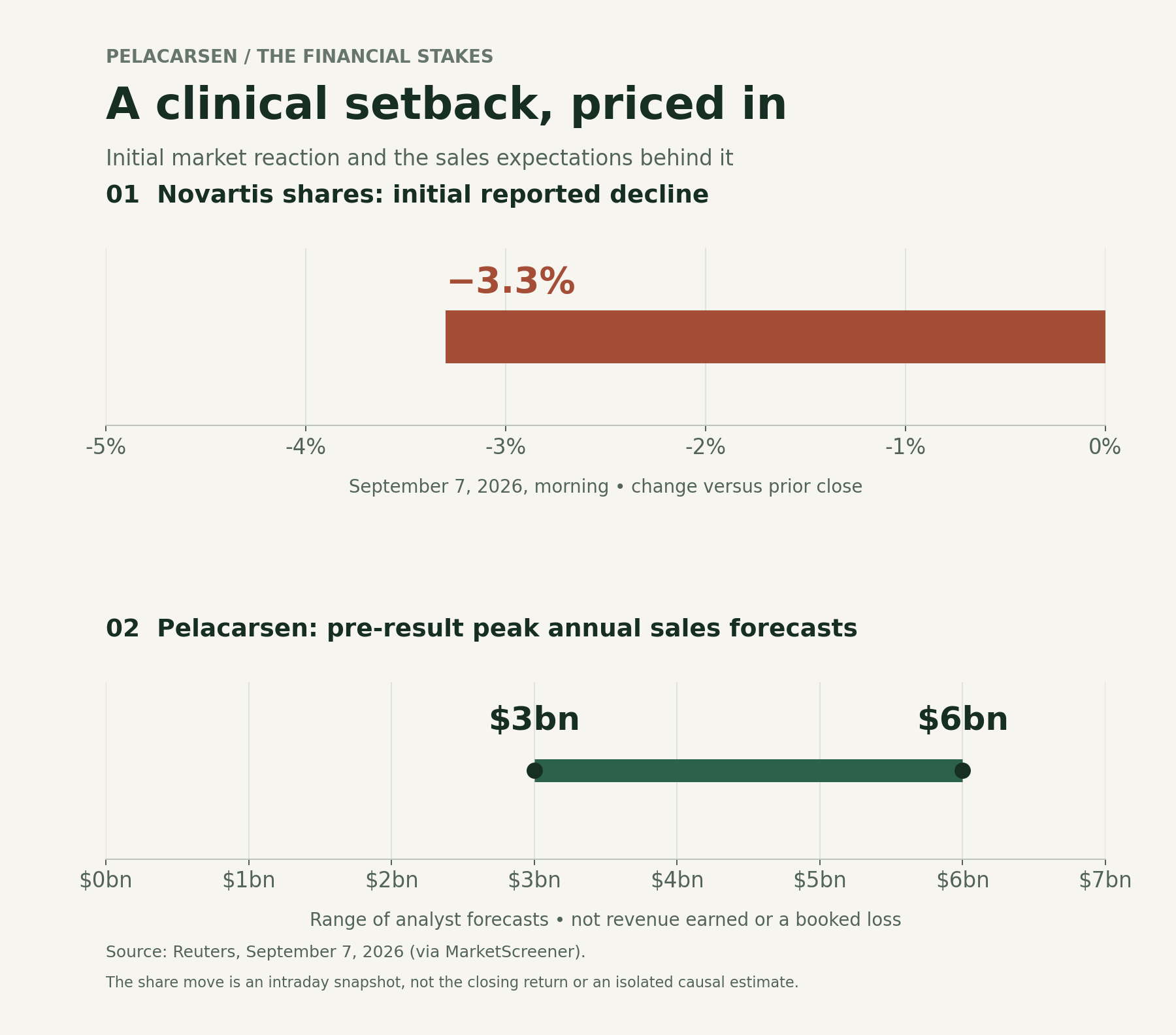
A forecast for peak annual sales is not the value of a drug. Investors also have to consider the probability of approval, how long sales take to develop, margins, royalties, competition, and the years of protection remaining. Nor can a company's whole stock-market decline be assigned to one product. Reuters was already discussing pressure from other parts of Novartis's pipeline in the same report.
For that reason, I would not present the larger selloff around this period as a clean estimate of the money lost because of pelacarsen. The initial reaction and the sales forecasts show the scale of expectations. They do not isolate the drug's valuation.
The scientific and financial uncertainty are connected. If investors become less confident that lowering Lp(a) will prevent events, that changes how they value competing programs too. Whether that pessimism is justified will depend on their results.
The other approaches
The pipeline is broader than pelacarsen. Different drugs intervene at different steps, with different dosing schedules and study populations. They still face the same requirement: demonstrate better clinical outcomes.
| Drug | Developer | Approach | Major outcomes trial |
|---|---|---|---|
| Pelacarsen | Novartis / Ionis | Antisense RNA targeting | Lp(a)HORIZON — NCT04023552 |
| Olpasiran | Amgen | Small interfering RNA | OCEAN(a)-Outcomes — NCT05581303 |
| Lepodisiran | Eli Lilly | Small interfering RNA | ACCLAIM-Lp(a) — NCT06292013 |
| Muvalaplin | Eli Lilly | Oral inhibitor of Lp(a) assembly | MOVE-Lp(a) — NCT07157774 |
Olpasiran reduces apolipoprotein(a) production through RNA interference, another way of silencing the message used to make the protein. Phase II data showed reductions exceeding 95% at week 36 with certain doses. Amgen's program includes both an outcomes trial in people with existing disease and a separate primary-prevention study, OCEAN(a)-PreEvent, in people at high risk of a first event. That distinction could help address the question of when treatment begins. Phase II results · Amgen's August 2026 development update
Lepodisiran also uses small interfering RNA, with an emphasis on sustained lowering. In the Phase II ALPACA study, the pooled 400-mg groups had a placebo-adjusted, time-averaged reduction of 93.9 percentage points between days 60 and 180. That is a biomarker result over a specified interval, not a 93.9% reduction in heart attacks. The larger ACCLAIM trial is designed to examine cardiovascular events. ALPACA paper
Muvalaplin takes a different route. It is an oral small molecule intended to interfere with the assembly of the Lp(a) particle, rather than silencing RNA. Its Phase II KRAKEN study also illustrates why comparisons require care: at the 240-mg dose, the placebo-adjusted reduction was 85.8% using an assay measuring intact Lp(a), but 68.9% using an apo(a)-based assay. How the particle is measured changes the reported number. KRAKEN randomized trial
There are additional programs, including the siRNA drug zerlasiran, which has published Phase II results. That expands the number of ways researchers can test the biology, but it does not yet supply cardiovascular-outcomes evidence. ALPACAR-360 paper · NCT05537571
These studies are not head-to-head comparisons. Ranking the drugs by their largest advertised percentage reduction would ignore differences in dose, assay, population, and follow-up. HORIZON is a reminder that the eventual ranking should depend on outcomes and safety.
What I am watching next
The immediate priority is the full HORIZON presentation and paper. As of September 22, I have not found a confirmed congress name or presentation date in the company's announcement or the other sources reviewed. I would rather leave that date open than turn an expected conference appearance into a fact.
For the other major trials, these are the current registry estimates:
| Study | Estimated primary completion | What that date means |
|---|---|---|
| OCEAN(a)-Outcomes | March 31, 2028 | Expected collection of the final primary-outcome data; not a promised announcement date |
| ACCLAIM-Lp(a) | March 2029 | Estimated primary completion |
| MOVE-Lp(a) | March 2031 | Estimated primary completion |
These are planning dates, checked against ClinicalTrials.gov on September 22, 2026. They can change. Analysis and publication may follow later, and a sponsor may announce a different readout schedule.
When the HORIZON data arrive, I want to return to the absolute event rates, confidence intervals, individual endpoints, higher-Lp(a) analysis, and safety findings. That should let us say more about what failed and what remains plausible.
I had hoped this would give people another effective way to reduce their risk. It is disappointing that the trial did not establish that benefit. I am still following the field, and I would like the next essay to be about what the full evidence teaches us, rather than what we can infer from a headline.